
Selecting the correct structural engine for your corporate digital storefront is one of the most critical financial decisions an executive team can make. The chosen system affects daily order processing speed, customer retention rates, and the long-term appreciation of your digital corporate assets. WooCommerce provides a highly compelling operational case for mid-market and enterprise operations looking to scale efficiently without platform friction.
Complete Creative Freedom and Customization Power
Standard hosted web platforms often force growing businesses to alter their real-world operational workflows to fit the rigid technical limitations of a pre-built layout. WooCommerce completely reverses this dynamic by providing an open application layer where your digital interface adapts entirely to your specific business rules.
Companies can break away from generic templates to construct highly memorable, fast-rendering user paths that match corporate identity guidelines perfectly. Whether your daily operations require unique localized checkout fields, interactive B2B quotation mechanisms, or deep custom product configurators, the open environment easily supports specialized development additions. This degree of flexibility helps you retain control over the customer conversion funnel at every stage of growth.
Cost-Effective Open-Source Infrastructure
Traditional enterprise software regularly demands steep monthly licensing fees, unpredictable transaction-percentage penalties, and mandatory tier upgrades that cut directly into your gross profit margins. Because WooCommerce uses an open-source model, the foundational core framework is entirely free from recurring software usage fees or platform taxes.
This distinct financial structure shifts your web capital allocation from an ongoing operational liability into an appreciating corporate asset. Instead of paying software rents to an external software platform provider, companies can strategically reinvest their development budgets into custom backend tools, third-party logistics syncing, advanced conversion rate optimization, and aggressive customer acquisition campaigns. Over a multi-year period, this financial efficiency drastically improves your total return on digital investments.
Seamless Integration with the WordPress Ecosystem
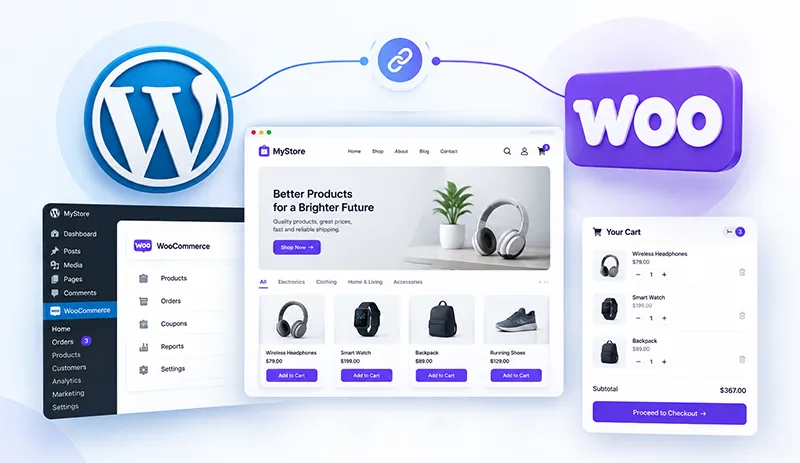
An online shop cannot thrive in isolation without a structured method for attracting, educating, and retaining buyers over time. Because WooCommerce is developed natively directly into the core of WordPress, your digital store inherits the unmatched advantages of the world’s most sophisticated content management engine.
This close system architecture bridges the historical gap between brand marketing and transactional retail workflows. Your technical partners can easily deploy complex inbound lead-generation hubs, authoritative content structures, and deep product documentation systems that work in perfect harmony with your central inventory database, creating an organic search visibility engine that standard SaaS builders cannot replicate.
Absolute Data Ownership and Security Control
In the modern corporate landscape, customer records, transaction histories, and behavioral analytics represent incredibly valuable intellectual property. Relying on a closed, third-party hosted platform means trusting your proprietary operational intelligence to an external entity that retains ultimate control over your database access rules.
With WooCommerce, your business maintains absolute, uncompromised ownership of every data point generated across your web channels. You select the precise cloud server infrastructure, dictate internal database access parameters, and manage security firewalls. This granular control is vital for regulatory compliance, allowing exact adherence to localized data protection acts, corporate data preservation policies, and strict internal security audits without external platform interference.
Building a high-performing digital storefront requires a systematic, professional development methodology. This comprehensive master roadmap details every operational step required to take a digital storefront from initial concept to a fully optimized, revenue-generating asset, ensuring absolute structural integrity throughout the journey. Learn more about building an online store with WooCommerce.
Step 1: Discovery, Competitor Research, and Technical Scoping
Before a single line of code is written, a professional team aligns the technical strategy with concrete business objectives. This phase maps the commercial requirements directly to software functions.
Analyzing Competitor Digital Architecture
Evaluating rival storefronts to identify industry standards, usability gaps, and opportunities for functional differentiation. WooCommerce developers investigate the technical integrations, scripts, and interface mechanics used by high-performing competitors.
By understanding the technological baseline of your industry, developers can identify common performance bottlenecks, usability gaps, and opportunities to deploy superior functional enhancements that give your business a distinct marketplace advantage.
Defining the Minimum Viable Product Feature Set
Mapping out the exact plugins, custom integrations, and core workflows needed for launch to manage project timelines efficiently. To maintain tight project timelines and optimize initial launch budgets, developers work closely with your leadership team to define the critical feature set required for launch.
This involves choosing the ideal core extensions, determining what requires custom development, and identifying secondary features that can be rolled out in subsequent development sprints. This clear, strategic documentation prevents scope creep and ensures a highly focused, stable initialization process.
Step 2: Selecting Optimized Hosting and Core Infrastructure Setup
A fast, stable storefront relies entirely on the quality of the underlying hosting environment. The long-term performance, reliability, and security of your online store depend heavily on the quality of the underlying hosting architecture and server environment.
Vetting Enterprise-Grade Managed WordPress Hosting
Choosing a high-performance host with built-in staging environments, automated daily backups, and server-side caching developed for eCommerce. A standard, low-cost shared hosting account is entirely inadequate for a serious business storefront.
A professional WooCommerce store setup requires isolated, cloud-based, or enterprise-grade managed server environments specifically optimized for database-heavy environments. This advanced infrastructure guarantees that your store remains fast, responsive, and available even during sudden influxes of promotional web traffic.
Deploying Core Software and Database Optimization
Installing WordPress and WooCommerce using clean database prefixes and optimized configurations to ensure rapid page load times. Once the ideal server infrastructure is secured, experts install the core software ecosystem. This process involves setting up a clean database structure using non-standard table prefixes to mitigate common security vectors.
Developers tune the database engine settings, optimize the memory allocation limits, and establish high-performance server-side rules to minimize initial query latency, ensuring a rapid foundation before any content or imagery is added to the system.
Step 3: Architecture Setup, Initial Installation, and Core Configuration
Establishing the structural and legal framework of the online store to guarantee operational compliance from day one. This phase ensures the basic platform configuration is complete and localized appropriately.
Establishing General Store and Localization Settings
Configuring currency rules, accurate tax calculations based on regional jurisdictions, and default shipping zones. This technical step involves defining the store’s primary geographical anchor point, setting exact currency parameters, and establishing international shipping zones.
Developers input precise regional tax matrices, configuring automated systems to calculate appropriate regional or state taxes at checkout based on the buyer’s verified location. This ensures absolute legal and financial compliance right from the start.
Configuring Core Inventory and Order Management Parameters
Setting up automated stock alerts, low-stock thresholds, and system notifications for streamlined back-office fulfillment. A streamlined back-office operation relies on automated data tracking. Developers configure the system’s core inventory settings, establishing automated low-stock and out-of-stock notification loops for your warehouse teams.
They map specific checkout events to trigger appropriate customer notifications, legal receipt distribution, and automated invoice creation, setting up an efficient framework for back-office fulfillment teams.
Step 4: Bespoke UI/UX Design and Brand Customization

Transforming a vision into a visually stunning, responsive interface that builds immediate trust with customers. An online store must instantly convey professionalism and brand trust while guiding users effortlessly toward completing a purchase.
Custom Theme Development vs. Lightweight Framework Engineering
Building a high-performance interface from scratch or customizing lightweight frameworks to ensure zero code bloat. When executing a professional WooCommerce store creation, developers carefully weigh design complexity against raw speed.
Developers typically avoid heavy, bloated commercial themes packed with unnecessary code. Instead, they develop custom themes from scratch or heavily customize lightweight, developer-focused frameworks. This approach ensures your visual interface remains clean, modern, and free from unnecessary code scripts, resulting in exceptionally fast page loading speeds.
Mobile-First Layout Optimization and Checkout Design
Development a flawless shopping experience across all mobile devices, focusing on reducing mobile cart abandonment. With a vast portion of global digital commerce occurring on mobile devices, the visual layout must be designed with a mobile-first mindset.
Developers meticulously optimize product archive grids, filter interfaces, and product pages for touch interactions. The checkout funnel is intentionally streamlined, removing unnecessary steps and optimizing form fields to minimize input friction and maximize mobile conversion rates.
Step 5: Secure Payment Gateway and Shipping Integration
Configuring the financial and logistical pipelines to ensure secure transactions and accurate delivery calculations. Ensuring secure customer financial transactions and accurate shipping calculations is paramount for protecting revenue and building consumer confidence.
Implementing Multi-Layered Security Protocols and SSL
Enforcing payment card industry data security standards, setting up specialized firewall rules, and securing customer account access. When planning to create a WooCommerce website, security cannot be treated as an afterthought.
Developers deploy advanced, multi-layered defensive frameworks across your platform. This includes enforcing strict Secure Sockets Layer encryption protocols, setting up Payment Card Industry Data Security Standard compliant environments, and installing specialized server-side web application firewalls. These measures protect customer data and shield your database from malicious bots and brute-force intrusion attempts.
Integrating Trusted Local and Global Merchant Gateways
Connecting essential payment solutions like Stripe, PayPal, or regional processors to support smooth, secure checkouts. To maximize conversion potential, your checkout funnel must offer the reliable payment options your audience prefers. Developers configure secure integrations with premier international merchant networks, such as Stripe and PayPal, alongside specialized regional payment processors.
By utilizing advanced tokenization systems, sensitive credit card details are securely passed directly to the financial institution without being stored directly on your server. This drastically reduces your corporate security liability while delivering a seamless, trustworthy transactional experience.
Advanced Shipping Matrix and Third-Party Logistics API Setup
Configuring live shipping rate calculators, flat-rate shipping rules, or direct integrations with external fulfillment networks. For businesses handling physical merchandise, accurate logistical calculations are critical for protecting profit margins.
Developers build advanced shipping rule matrices within the database, accounting for weight-based calculations, tiered regional shipping fees, and conditional free-shipping milestones. For complex fulfillment operations, developers integrate direct application programming interfaces with major courier networks and third-party logistics warehouses, enabling live tracking updates and real-time shipping cost calculations.
Step 6: Product Catalog Organization, Taxonomy, and Database Entry
Structuring products logically so that both customers and search engine crawlers can navigate the store effortlessly. A disorganized database can quickly slow down server performance and frustrate your customers. Properly structuring your content architecture is critical for long-term scalability.
Setting Up Complex Product Categories, Tags, and Attributes
Creating clean product hierarchies, filterable attributes, and variable product options without cluttering the store database. Establishing a clean data hierarchy is essential when learning how to set up a WooCommerce store for long-term expansion.
Developers build out a logical taxonomy using precise categories, intuitive tags, and filterable attributes (such as dimensions, materials, or color variations). This clean classification system allows users to navigate thousands of products effortlessly using fast, accurate faceted search filters, while avoiding database clutter.
Bulk Product Upload and Legacy Data Migration
Using professional database scripts to securely import existing product details, customer records, and order histories without data loss. For established brands transitioning from older, legacy web systems, migrating historical data is an incredibly delicate operation.
Professional developers use custom data-mapping scripts to securely import extensive product inventories, customer profiles, encrypted password records, and past purchase histories. This meticulous database work preserves critical operational information without losing a single line of data or breaking existing customer account access.
Step 7: Technical SEO Implementation and Product Page Optimization
Optimizing the store architecture prior to launch to ensure rapid indexing and high search engine visibility. A beautiful digital storefront is only valuable if your potential target audience can easily find it online. Incorporating search engine optimization directly into the development cycle is a core requirement for a modern store. Our eCommerce SEO experts ensure your WooCommerce store is built with search visibility and long-term organic growth in mind.
Product Schema Markup and Technical URL Architecture
Injecting clean structured data so search engines display rich snippets like pricing, reviews, and stock availability directly in search results. To maximize performance in modern search ecosystems and AI-driven answer overviews, developers carefully refine the site’s underlying technical code structure.
They implement clean, logical permalink URL hierarchies that search engines can easily read. Crucially, developers inject highly structured JSON-LD product schema markup across the store. This technical step passes explicit, structured details—including real-time pricing, stock availability, aggregate star ratings, and brand identifiers—directly to search engine crawlers, resulting in eye-catching rich snippets within search results.
Optimizing Product Metadata, Copy, and Media Assets
Crafting search-friendly meta titles, descriptive alt tags for images, and fast-loading media galleries to maximize conversions. This step ensures that individual product pages are fully optimized for both search algorithms and human buyers.
Developers and digital strategists build out optimized templates for meta titles and descriptions while ensuring all high-definition product imagery is compressed, sized correctly, and paired with descriptive, keyword-optimized alternative image text. This significantly improves page indexing speeds while delivering a highly engaging, informative experience for your visitors.
Step 8: Rigorous Quality Assurance, Testing, and Performance Tuning
Comprehensive testing protocols to find and fix bugs before the store goes live to the public. Before opening your digital storefront to the public, the entire platform must undergo strict, comprehensive technical testing to identify and eliminate bugs.
End-to-End Cross-Browser and Cross-Device Testing
Verifying that every button, form, and visual asset works perfectly across Safari, Chrome, iOS, and Android systems. A professional development team leaves absolutely nothing to chance.
They run the entire codebase through automated testing suites and manual reviews across multiple operating systems, device types, and browser engines (including Apple Safari, Google Chrome, Mozilla Firefox, and Microsoft Edge). This ensures that layout grids, buttons, drop-down menus, and pop-up notifications display beautifully and perform flawlessly for every single visitor.
Live Transaction Testing and Sandbox Checkouts
Running real financial transactions in sandbox mode to confirm that payment processors, tax calculations, and email receipts function flawlessly. Developers run comprehensive transactional tests by simulating real-world purchasing behavior within live developer sandbox modes.
They verify that discount codes calculate accurately, tax rules apply correctly across various shipping destinations, inventory numbers update immediately upon order completion, and automated system emails reach customer inboxes without getting caught in spam filters.
Database Cleanup, Asset Compression, and Speed Optimization
Minifying code files, compressing product images, and tuning server response times to achieve optimal scores on performance testing tools. To ensure blazing-fast performance, developers conduct a thorough post-development optimization pass.
This involves cleaning up temporary database entries, minifying CSS and JavaScript files, configuring advanced object caching arrays, and optimizing server response times. These steps help your store achieve excellent scores on core performance benchmarking tools, which directly benefits your search engine visibility and user conversion rates.
Step 9: Pre-Launch Checklist and Final Store Deployment
Executing a seamless transition from the private development staging environment to the live public domain. This phase manages the risk of going live.
Final Database Sync and Permalink Configuration
Running a final check to ensure all internal links point to the live URL and that there are no broken pathways. Immediately prior to launching, developers perform a final synchronization of the live database.
They carefully verify that all internal links, image paths, and API connections point correctly to your live production domain, completely eliminating the risk of broken links or missing image assets.
Flipping the Live Switch and Search Engine Indexing
Removing the site construction barrier, generating a dynamic XML sitemap, and submitting it to Google Search Console to jumpstart indexing. With all checklists completed, the team removes the private staging barriers and pushes your new storefront live to the global web.
Developers immediately generate an optimized XML sitemap and submit it directly to platforms like Google Search Console. This tells search engine crawlers to immediately begin indexing your new pages, setting the stage for organic traffic generation right from day one.
Step 10: Post-Launch Marketing, Analytics, and Continuous Optimization

Executing active external marketing campaigns to drive targeted traffic, capture leads, and scale conversions once the storefront is officially live. A successful launch is simply the foundation for your long-term digital growth. Sustained business success requires continuous optimization and data-driven marketing.
Generative Engine Optimization and Ongoing SEO
Expanding content strategies and optimizing structure for discovery across AI-driven search engines and traditional platforms. By capitalizing on the deep, native WordPress integration established during setting up a WooCommerce website, your brand can confidently scale its organic marketing efforts. Marketing teams can easily publish rich buying guides, industry insights, and digital PR content to attract high-quality organic traffic.
PPC Advertising and Retargeting Campaigns
Launching targeted Google Ads, social media advertising, and dynamic product retargeting campaigns using pre-configured tracking codes. This allows marketing teams to monitor complete customer lifecycles, pinpoint precise drop-off zones within your sales funnel, and accurately measure the return on investment of your various marketing campaigns.
Lifecycle Email and SMS Marketing Automation
Activating customer retention platforms to trigger automated flows for abandoned cart recovery, welcome series, and customer win-backs. To recover potentially lost revenue, developers set up smart, automated marketing workflows. When a user leaves items behind in their cart, the system automatically triggers a personalized recovery sequence to guide them back to complete their order.
Conversion Funnel Analytics and Data Tracking
Integrating tools like Google Analytics 4 to monitor real-world user behavior and identify drop-off points within the checkout funnel. To help you make smart, data-driven decisions, professionals install advanced analytical tracking frameworks and custom conversion tracking pixels. This data shows exactly how users interact with your site so you can back up your business strategies with clear facts.
Continuous Performance Optimization and Testing
Running ongoing speed tune-ups, database cleanups, and A/B conversion tests to keep the storefront running at peak efficiency. A launch is just the beginning of your growth, and web performance naturally changes over time as your catalog expands. Regularly auditing page speeds, optimizing media assets, and testing user interface tweaks ensures your store maintains a high conversion rate.