
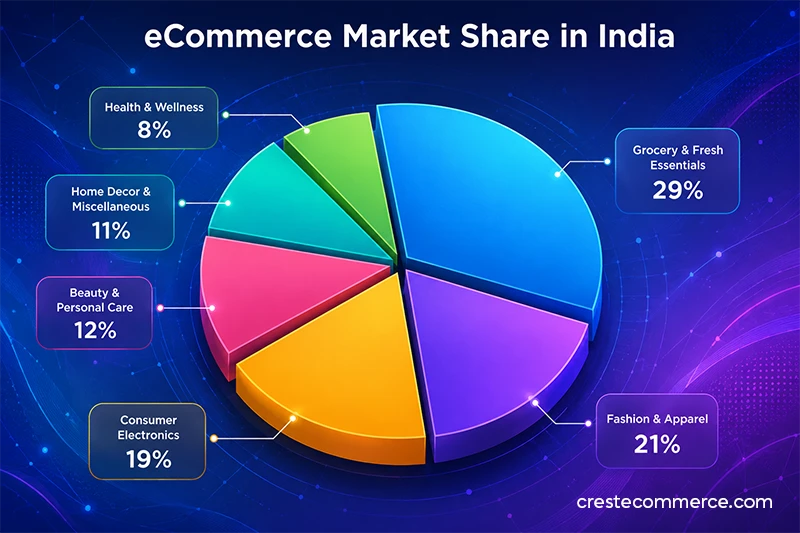
The structural architecture of consumer spending across the country demonstrates a highly dynamic distribution of digital sales. To evaluate the competitive landscape accurately, one must look at how the eCommerce market share in India is apportioned across key industry verticals. Modern retail data reveals that the digital market has matured past early experimental phases into an ecosystem where specific everyday categories control distinct chunks of national sales volume.
Grocery and Fresh Daily Essentials
The dramatic rise of quick commerce services has pushed the food and grocery sector to the top of the digital retail landscape. This segment currently commands 29% of the total eCommerce market share in India. Driven heavily by dense networks of local dark stores and sub-15-minute delivery options, this high-frequency category has successfully turned standard brick-and-mortar supermarket trips into regular on-demand mobile purchases.
Fashion and Apparel Accessories
The lifestyle vertical is a massive engine for transaction volume. Clothing, footwear, and fashion accessories secure 21% of the digital market. This sector thrives on deep consumer engagement and continuous trend cycles. Online apparel platforms have managed to break through traditional geographic barriers by opening up premium styles to younger demographics living in expanding regional towns.
Consumer Electronics and Mobile Devices
While smartphones and personal tech items used to lead the entire market, longer replacement timelines have shifted their overall volume. Consumer electronics now represent 19% of the national online retail value. Even with lower daily purchase frequencies compared to groceries or clothes, this category remains a vital pillar for major digital platforms because it holds a remarkably high average order value.
Beauty and Personal Care Products
The beauty and cosmetics industry has carved out a highly profitable 12% market share. This specific category is undergoing a major shift away from mass-market chemical blends toward clean, toxin-free, and regional skincare or hair formulations. Strong gross profit margins and the rapid scaling of native Direct-to-Consumer beauty brands make this a premier entry point for new businesses.
Health and Wellness Segments
Medical supplies, personal wellness products, and fitness goods make up 8% of the online shopping ecosystem. This footprint reflects a permanent shift in consumer priorities toward health management and proactive personal care.
Home Decor and General Miscellaneous Goods
The final 11% of the online market belongs to home improvement, toys, kitchen appliances, and various niche hobby supplies. This collective segment represents the long tail of digital retail, expanding consistently alongside rising middle-class disposable incomes.
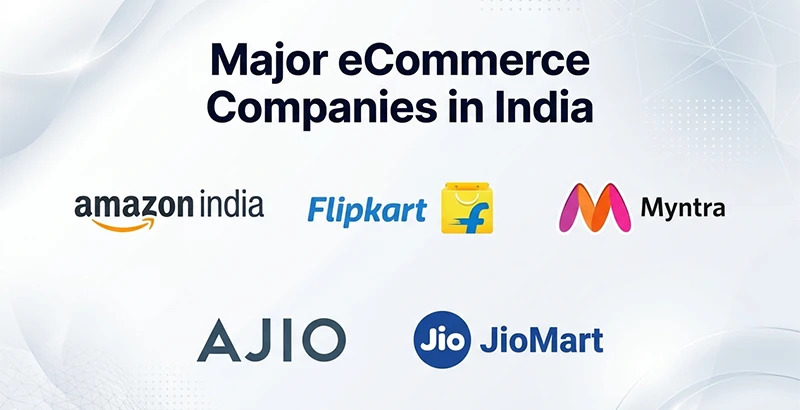
The market’s structural development is heavily influenced by several of the biggest eCommerce companies in India, which have spent years building infrastructure, establishing logistics networks, and cultivating digital consumer trust.
Amazon India
Amazon India operates one of the country’s largest ecommerce ecosystems, offering millions of products across diverse categories. Its extensive fulfillment network, Prime membership benefits, reliable delivery infrastructure, and customer-centric services have made it one of India’s most trusted online marketplaces.
Flipkart
Flipkart is India’s leading homegrown ecommerce marketplace, serving millions of customers with products spanning electronics, fashion, home essentials, and more. Its extensive logistics network, competitive pricing, festive sales events, and strong regional reach continue to drive widespread consumer adoption.
Myntra
Myntra is India’s leading online fashion and lifestyle marketplace, offering apparel, footwear, accessories, and beauty products from domestic and international brands. Personalized recommendations, virtual shopping features, and trend-focused collections make it a preferred destination for fashion enthusiasts.
Ajio
Ajio, backed by Reliance Retail, has established itself as a prominent fashion ecommerce platform featuring exclusive international labels, private brands, and affordable collections. Its omnichannel presence, competitive pricing, and curated product selection appeal to a broad customer base.
Reliance JioMart
Reliance JioMart combines digital commerce with Reliance’s extensive retail network to offer groceries, daily essentials, electronics, and household products. Its integration with neighborhood stores, competitive pricing, and convenient delivery services strengthens its position in India’s ecommerce ecosystem.
Launching an enterprise in the Indian market requires a healthy mix of regional operational groundwork and smart digital engineering. This practical guide walks you through localized niche evaluation, compliance requirements, platform choices, and fulfillment structures across ten sequential steps.
Step 1: Identifying a Profitable Niche
A common mistake is trying to sell everything to everyone. Success lies in finding a focused category where you can leverage regional manufacturing or production advantages.
- Researching Local Supply and Global Demand: To find a winning product, look at what regional clusters produce best and match it with market desires. Master the use of Google Trends and marketplace search volume data to uncover high-margin product opportunities. For instance, finding a spike in demand for sustainable goods gives you a massive pricing edge if you source close to dedicated crafting clusters.
- Defining the Indian Target Persona: Map out demographics across diverse segments, ranging from tech-savvy young professionals in urban metros who look for premium convenience, to value-conscious shoppers across Tier-2 and Tier-3 territories who prioritize discounts, warranties, and clear utility.
- Evaluating Product Unit Economics: Analyze the durability of products traveling from major transit hubs, verify optimal weight brackets to prevent inflated shipping margins, and identify return-resilient item categories. If an item is heavy, fragile, and prone to high returns, reverse logistics will swallow your profits.
Step 2: Selecting and Verifying Suppliers
Once your niche is clear, you need to secure a reliable, high-quality supply of products.
- Physical Goods vs. Digital Offerings: Balancing the storage and logistical frameworks required for tangible products against the asset-light, borderless nature of digital products (like e-books, courses, or software designs) is an essential strategic choice.
- Navigating Sourcing Channels: Evaluate the financial viability of bulk manufacturing in regional industrial plants versus dropshipping models or high-volume wholesale sourcing from local trade hubs. Bulk manufacturing offers higher margins but requires upfront capital, while dropshipping lowers initial financial risk.
- Strict Quality Control & Compliance Protocols: Establishing on-site quality assurance routines before stock leaves regional factories is vital to prevent high return rates and protect brand integrity. Never ship items directly from a new supplier to a customer without personally checking the quality first.
Step 3: Architecting a Distinct Brand Identity
With thousands of stores online, your brand identity is what makes a customer choose you over a competitor. It represents your promise of quality and service.
- Securing a Distinct Domain & Brand Name: Focus on finding clean, memorable brand names that resonate clearly with an Indian consumer base while ensuring exact matches across primary domain registries like .in and .com.
- Developing Cohesive Brand Visuals: Craft crisp, recognizable logos, typography, and color schemes that translate perfectly onto physical product packaging and digital assets to build trust from day one.
- Formulating Your Unique Selling Proposition (USP): Clearly communicate your edge, whether it is express regional shipping, zero-plastic sustainable packaging, or deep factory-direct pricing. Your USP should be prominently displayed on your homepage.
Step 4: Selecting the Ideal Platform for Indian Operations
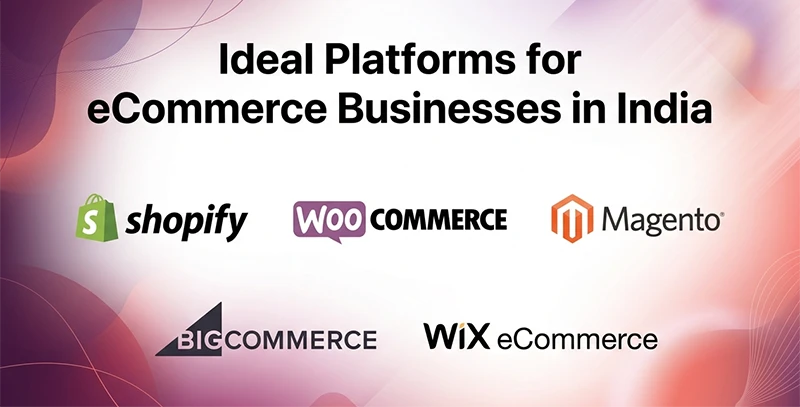
Your eCommerce platform is the foundation of your digital storefront. Choose a system that matches your technical comfort level and business scale. Transforming these frameworks into a conversion-optimized storefront often benefits from a creative design layout to handle custom visual assets and localized styling.
- Shopify: Highly recommended for rapid D2C deployments due to its excellent plug-and-play app support for domestic shipping providers and Indian payment gateways. Working with professionals for Shopify development in India allows brands to maximize these features efficiently, though this ease of setup is offset by recurrent subscription fees.
- WooCommerce: Ideal for content-heavy stores and flexibility because it provides maximum code-level customization and zero monthly platform commissions. Utilizing specialized WooCommerce development services in India helps businesses scale this WordPress extension safely without running into severe hosting or security resource bottlenecks.
- Magento (Adobe Commerce): Perfect for enterprise-grade retail as it is specifically designed for vast multi-warehouse catalogs and handling massive customer traffic. Because it remains highly complex and resource-intensive, onboarding experienced Magento developers in India is vital to maintain database stability and fast load times.
- BigCommerce: Suited for medium to large scaling brands, delivering robust, out-of-the-box multi-channel sync features and strong built-in SEO tools. This platform is perfect for enterprises wanting a balance between SaaS ease and deep operational scale, though it comes with a steeper learning curve for complete beginners.
- Wix eCommerce: Tailored for boutiques and solo creators, featuring a simplistic drag-and-drop builder perfectly suited for testing initial product ranges with minimal operational complexity, though it offers limited customization options for advanced scaling down the line.
Step 5: Securing High-Performance Hosting
If your website is slow, customers will leave before even looking at your products. A reliable hosting setup keeps your digital doors open smoothly.
- Domain Registration Strategy: Align the core web address cleanly with your business name to maximize direct brand recalls and optimize local search footprints. Secure both .in and .com to lock down your brand namespace.
- Hosting Architecture & Speed Compliance: Selecting cloud hosting providers with Indian server locations (e.g., Mumbai/Delhi data centers) guarantees fast page-load speeds, high uptime security, and smooth traffic scaling during major festive sales.
Step 6: Design Frameworks and User Experience (UX)
A well-designed store guides a visitor effortlessly from discovery to payment. The user experience should feel intuitive and friction-free.
- Mobile-First Design Execution: The vast majority of Indian internet users shop on their smartphones. You must ensure that navigation, image scales, and call-to-action buttons are fully optimized for mobile devices.
- Simplified Navigation and Search Architecture: Creating intuitive category hierarchies and clear filtering layers helps shoppers find specific products with minimal clicks. Features like auto-suggest search bars assist users instantly.
- Optimizing Core Conversion Assets: Your product page needs to replace the physical experience of touching a product by engineering high-converting product detail pages containing detailed multi-angle imagery, precise item specs, transparent pricing, and visible trust badges.
Step 7: Core Architecture and Checkout Features
The checkout process is where a visitor officially transforms into a paying customer. Any confusion here can lead to a lost sale.
- Streamlined Checkout Mechanics: Minimizing data entry fields on checkout screens reduces cart abandonment rates, ensuring a smooth, single-page path from cart to purchase.
- Payment Gateway Integration: Deploying robust payment processing systems that offer frictionless UPI options, credit/debit card routes, net banking, and reliable COD tracking systems ensures a seamless experience. Platforms like Razorpay or Cashfree are highly popular choices.
- Customer Portal Deployments: Building out personal user portals allows customers to view live tracking information, review order history, and maintain individual product wishlists, reducing pressure on your support team.
- Automated Shipping Real-Time Tracking: Embedding automated tracking widgets that update buyers across key delivery milestones via SMS or WhatsApp reduces customer support inquiries and builds peace of mind.
Step 8: Order Management and Operational Workflows

Behind a beautiful storefront lies a complex backend operation. Smooth workflows ensure that every order is processed accurately and promptly.
- Real-Time Stock Synchronization: Implementing automated inventory counters across your web store and active marketplaces prevents accidental overselling of out-of-stock items, protecting your seller ratings.
- Dedicated Inventory Automation Software: Utilizing central management systems helps automate reorder thresholds, optimize stock distributions across multiple hubs, and provide clear margin clarity.
- Streamlined Order Fulfillment Workflows: Speed up your backend operations by creating smooth internal processing tracks, from printing invoices and pick-lists to packing and handover to courier fleets.
Step 9: Legal Architecture and Corporate Compliance
Disclaimer: eCommerce regulations change frequently. Conduct your own independent research and consult with a certified legal professional before starting business operations.
- Business Licensing Frameworks: Secure your legal identity by obtaining essential registrations including sole proprietorship, LLP, or private limited incorporation, alongside mandatory local commercial licenses like the Shops and Establishments registration via your regional state labor department portal.
- GST Registration & Tax Management: Structuring the business under the Goods and Services Tax (GST) framework ensures accurate tax calculation across varying state boundaries and HSN codes. Since eCommerce platforms require a GST number to onboard sellers, getting this sorted early is mandatory.
- Required Digital Policies: Protect your business legally by drafting transparent, legally compliant website pages covering user privacy details, terms of service agreements, and explicit consumer refund guidelines.
Disclaimer: This information is intended for general educational purposes only and should not be considered legal, tax, or financial advice. Ecommerce regulations may change over time. Always consult qualified legal and tax professionals before making business or compliance decisions.
Step 10: Tailoring Packaging and Strategic Shipping
Your product packaging is the first tangible interaction a customer has with your brand. It needs to be secure, cost-effective, and professional.
- Strategic Logistic Partnerships: Focus on selecting reliable shipping networks or third-party logistics aggregators capable of managing fragile items, handling high cash volumes for COD orders, and offering broad pin-code reach across tier-2 and tier-3 towns.
- Branded, Functional Packaging Solutions: Designing protective packaging prevents transit damage while providing a premium unboxing experience that builds brand loyalty and encourages social media sharing.
- Transparent Delivery Terms: Defining clear, up-front shipping costs and realistic transit timelines on your site establishes customer trust from day one and sets realistic expectations.
The rapid evolution of consumer psychology and tech capabilities has introduced a wave of eCommerce industry trends that are redefining how businesses operate and how individuals shop online. Staying competitive requires deep synchronization with these macro shifts.
1. Generative AI and Automation
Generative AI is helping ecommerce businesses automate content creation, personalize customer interactions, optimize marketing campaigns, and improve operational efficiency while reducing manual effort and accelerating decision-making across multiple business functions.
2. Advanced Data Management
Businesses are integrating customer data from multiple channels into unified platforms, enabling better audience segmentation, personalized shopping experiences, improved marketing performance, and more informed business decisions.
3. Conversational Commerce and Regional Chatbots
AI-powered chatbots with multilingual and voice capabilities are making online shopping more accessible by assisting customers in regional languages and providing personalized, real-time support throughout the buying journey.
4. Headless Commerce
Headless commerce separates the frontend from the backend, allowing businesses to build faster, highly customizable storefronts while delivering seamless shopping experiences across websites, mobile apps, and other digital channels.
5. Circular Economy and Resale Commerce
Brands are embracing sustainability by introducing certified resale programs, trade-in services, and refurbished products, extending product lifecycles while appealing to environmentally conscious and value-driven consumers.
6. Social Commerce
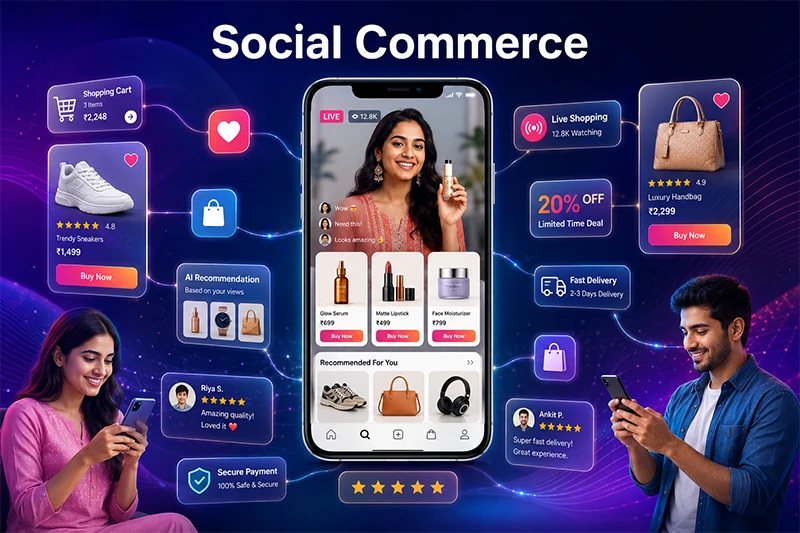
Social media platforms are becoming major shopping destinations, enabling brands to showcase products through influencers, live shopping, and short-form videos while allowing customers to purchase without leaving the platform.
7. Interactive Product Content
Videos, 360-degree product views, virtual demonstrations, and live shopping events provide customers with richer product experiences, increasing purchase confidence while reducing return rates and customer uncertainty.
8. Hyper-Personalized Loyalty Programs
Modern loyalty programs use customer data and AI to deliver personalized rewards, exclusive offers, early product access, and tailored shopping experiences that encourage repeat purchases and long-term customer retention.
9. User-Generated Content (UGC)
Customer reviews, ratings, photos, and unboxing videos create authentic social proof that builds trust, improves purchase confidence, and significantly influences buying decisions for prospective online shoppers.
10. Subscription-Based Commerce
Subscription models provide customers with automatic deliveries of frequently purchased products while helping businesses generate recurring revenue, improve inventory planning, and strengthen long-term customer relationships.